


In Texas, liability in a cyclist vs. pedestrian accident goes to whoever failed to use reasonable care, judged against right-of-way rules in the Transportation Code. Pedestrians generally have the right of way in crosswalks, but must yield when crossing outside one. Fault is often shared, and under Texas law you can recover only if you are 50 percent or less at fault, with damages reduced by your share. Because auto insurance usually does not apply, homeowners or renters policies often pay. Call 972-392-1249 for a free case review.
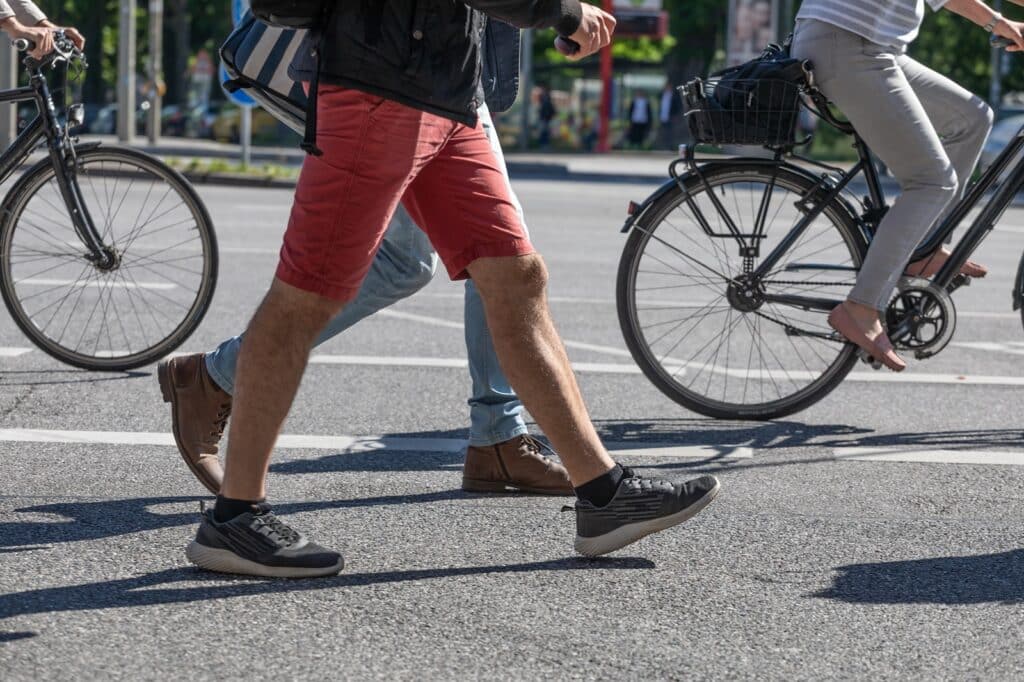
Most bicycle injury cases involve a car. Collisions between a cyclist and a pedestrian are different. Both people are unprotected, both can be badly hurt, and neither one is usually carrying an auto policy that covers the crash. On a crowded Dallas trail or a downtown street, a single step off a curb or a pass taken a little too fast can leave both sides injured and pointing at each other.
This guide explains how Texas decides who is at fault, how shared fault affects your recovery, where the money actually comes from, and what evidence wins these cases. It is written by Cyclist at Law, where Board-Certified trial lawyer Bill Shirer represents injured cyclists in Dallas and across Texas.
Who Is Liable When a Cyclist and a Pedestrian Collide in Texas?
The person who failed to act with reasonable care under the circumstances, and often both people share responsibility. Texas treats a cyclist as the operator of a vehicle. Under Transportation Code Chapter 551, a person riding a bicycle has the rights and duties of a vehicle driver. Pedestrians have their own rights and duties under Transportation Code Chapter 552. A jury or insurance adjuster compares each person's conduct against those rules and assigns a percentage of fault to each.
That means there is no automatic winner. A pedestrian is not always right because they were on foot, and a cyclist is not always at fault because they were moving faster.
What Do Texas Right-of-Way Laws Say?
Pedestrians usually have the right of way in crosswalks and on sidewalks, but they lose it when they cross mid-block or step out suddenly. The rules that come up most often in these cases:
Rule | What It Requires | Source |
Cyclists follow vehicle rules | A cyclist has the rights and duties of a driver, including obeying signals and yielding where required | Transp. Code 551.101 |
Pedestrian right-of-way in crosswalks | Vehicle operators must yield to a pedestrian crossing in a crosswalk where no signal controls traffic | Transp. Code 552.003 |
No sudden steps off the curb | A pedestrian may not suddenly leave a curb and move into the path of a vehicle so close that yielding is impossible | Transp. Code 552.003 |
Crossing outside a crosswalk | A pedestrian crossing anywhere other than a crosswalk must yield to vehicles on the roadway | Transp. Code 552.005 |
Use the sidewalk | Where a sidewalk is available, pedestrians may not walk along the roadway | Transp. Code 552.006 |
Due care toward pedestrians | Every vehicle operator, cyclists included, must exercise due care to avoid hitting a pedestrian | Transp. Code 552.008 |
Lights at night | A bike ridden at night needs a white front lamp and a red rear reflector | Transp. Code 551.104 |
What About Sidewalks and Shared-Use Trails?
Texas has no statewide ban on riding a bicycle on a sidewalk, but cities can restrict it locally, especially in business districts. On a shared-use trail, walkers, runners, and riders all owe each other a reasonable lookout. A cyclist who passes without warning at speed carries more risk of fault; a walker who swings across the path without looking carries more risk on their side. If the trail itself caused the crash, the claim against the owner follows different rules, explained in our guide to the Texas Recreational Use Statute.
Who Is Usually at Fault in Common Bike vs. Pedestrian Crashes?
Fault follows the facts, but these patterns show up again and again. The table below shows how liability typically leans in common situations. Real cases turn on evidence, so treat these as starting points rather than guarantees.
Scenario | Fault Usually Leans Toward |
Pedestrian steps into a bike lane mid-block while looking at a phone | Pedestrian (crossing outside a crosswalk, failing to yield) |
Cyclist runs a red light and strikes a walker in a marked crosswalk | Cyclist |
Pedestrian steps off a curb directly in front of a cyclist with no time to stop | Pedestrian |
Cyclist passes walkers on a crowded trail at speed with no warning | Cyclist, possibly shared |
Walker veers across a shared path without looking back | Pedestrian, possibly shared |
Night collision where the cyclist had no front light | Shared, with added fault on the cyclist |
Cyclist swerves to avoid a jaywalker and is hit by a car | Can be split among pedestrian, driver, and cyclist |
How Does Comparative Fault Affect Your Recovery?
You can recover only if you are 50 percent or less at fault, and your damages shrink by your share. Texas follows a modified comparative fault system under Civil Practice and Remedies Code Chapter 33. If a jury finds a cyclist 20 percent at fault and the pedestrian 80 percent at fault, the cyclist recovers 80 percent of their damages. At 51 percent or more, the cyclist recovers nothing.
Chapter 33 also lets a defendant designate a responsible third party, someone they claim caused or contributed to the crash. In a three-party collision, a driver who hit a cyclist may try to shift blame to the pedestrian who stepped out first. A careful liability case accounts for every person who could appear on the verdict form. Our guide to comparative negligence in bicycle accidents goes deeper.
Who Pays for Injuries in a Cyclist vs. Pedestrian Crash?
Usually a homeowners, renters, or umbrella liability policy, not auto insurance. A standard auto policy covers liability arising from a motor vehicle. When nobody was driving, that coverage generally does not apply. Instead:
If a pedestrian caused your injuries, the personal liability section of their homeowners or renters policy may cover your claim, even though the crash happened away from their home.
If you are a cyclist accused of causing a pedestrian's injuries, report the incident to your own homeowners or renters insurer promptly. Liability coverage often includes a defense, and late notice can create problems.
Umbrella policies can add liability coverage above a homeowners policy for serious injuries.
Your own health insurance typically pays medical bills first, then may seek repayment from any recovery.
Every rider should know what their own policies cover before a crash happens. See how to insure yourself as a cyclist and our overview of cyclist insurance coverage in Dallas.
What Evidence Proves Fault in a Bike vs. Pedestrian Collision?
Your own evidence matters more than usual, because police may not document these crashes the way they document car wrecks. The standard Texas crash report form is built around motor vehicle crashes, so a collision between a bike and a pedestrian may produce only a brief incident report, or none. Build the record yourself:
Photos of the scene, crosswalk markings, signals, sightlines, and lighting
Names and phone numbers of witnesses, plus the pedestrian's contact and insurance details
Ride data from Strava, Garmin, or Wahoo showing your speed and route at the moment of impact
Footage from a bike camera, nearby businesses, apartment buildings, or doorbell cameras, requested quickly before it is overwritten
Medical records that start the same day or the next day
Your damaged bike, helmet, and clothing, kept unrepaired until inspected
No witnesses? A claim can still be proven. Read how we approach a no-witness bicycle accident claim and what to do at the scene of a bicycle accident.
Where Do These Crashes Happen in Dallas?
Cyclist and pedestrian conflicts concentrate where both groups share tight space: the Katy Trail and its street crossings, the White Rock Lake loop on weekend mornings, the Santa Fe Trail, and dense walkable districts such as Downtown, Deep Ellum, Uptown, and Bishop Arts, where riders, walkers, and scooters all compete for room near curbs and crosswalks.
Statewide, the stakes are rising for everyone outside a car. According to TxDOT figures reported in a 2026 statewide safety campaign, Texas recorded 6,095 crashes involving pedestrians and 2,761 crashes involving bicyclists in 2024, with 772 pedestrians and 80 cyclists killed. The Texas A&M Transportation Institute publishes a helpful summary of the bike and pedestrian laws that apply in these crashes.
What Injuries and Damages Are Involved?
A cyclist thrown over the bars after hitting a pedestrian commonly suffers collarbone and wrist fractures, shoulder injuries, facial and dental trauma, and concussions. Pedestrians often suffer head injuries and fractures from the fall. When the other party is at fault, an injured cyclist can pursue:
Medical expenses, past and future
Lost wages and reduced earning capacity
Pain, mental anguish, and loss of enjoyment of riding
Bike, component, and gear damage (see handling bike damage claims)
Emotional injuries count too. Many riders develop anxiety or post-traumatic stress after a cycling accident, and those losses belong in the claim when properly documented.
What Should You Do After a Collision With a Pedestrian?
Check on everyone and call 911 if anyone is hurt. Ask for an officer to document the incident.
Get medical care the same day, even if you feel fine.
Exchange information, including names, phone numbers, addresses, and whether the other person has homeowners or renters insurance.
Photograph everything before the scene changes.
Avoid discussing fault at the scene or on social media.
Notify your own insurer if the pedestrian claims you caused their injuries.
Talk to a cycling attorney before giving a recorded statement to any insurance company.
Injured in a collision with a pedestrian in Dallas or anywhere in Texas? Bill Shirer will review the facts, identify every source of coverage, and tell you honestly where you stand. Call 972-392-1249 or request a free consultation online. There is no fee unless he wins.
How Cyclist at Law Handles Shared-Fault Cases
Shared-fault cases are won on details: sightlines, speed data, signal timing, and how a cyclist actually handles a bike in traffic. Bill Shirer is Board-Certified in Personal Injury Trial Law by the Texas Board of Legal Specialization, AV Preeminent rated by Martindale-Hubbell, and has more than 40 years of trial experience and more than 40 years of racing. He personally handles each case from his North Dallas office and represents cyclists throughout Texas.
Because he rides the same roads and trails as his clients, Bill can explain to an adjuster or jury why a cyclist's line, speed, or reaction was reasonable. Learn more about Bill or see why riders hire him.
Frequently Asked Questions
Who is at fault when a cyclist hits a pedestrian in Texas?
Whoever failed to use reasonable care under Texas right-of-way rules. Pedestrians generally have the right of way in crosswalks, but must yield when crossing elsewhere. Fault is often shared between the cyclist and the pedestrian.
Do pedestrians always have the right of way over cyclists?
No. Pedestrians have the right of way in crosswalks and on sidewalks, but under Transportation Code Section 552.005 they must yield when crossing outside a crosswalk, and they may not step off a curb into a vehicle's path too suddenly to avoid.
Can I recover if I was partly at fault?
Yes, if you were 50 percent or less at fault. Texas uses modified comparative fault under Civil Practice and Remedies Code Chapter 33. Your damages are reduced by your percentage of fault, and at 51 percent or more you recover nothing.
A pedestrian walked in front of my bike. Can I sue them?
Yes. If a pedestrian's carelessness caused your crash, you can bring a negligence claim. Recovery usually comes from the personal liability coverage in the pedestrian's homeowners or renters insurance policy.
Does auto insurance cover a bicycle vs. pedestrian accident?
Usually not, because no motor vehicle was involved. Homeowners, renters, and umbrella liability policies are the most common sources of payment, along with each person's own health insurance.
Can a pedestrian sue me if I hit them on my bike?
Yes. Cyclists owe pedestrians reasonable care. If a pedestrian claims you caused their injuries, notify your homeowners or renters insurer promptly, since liability coverage often includes a legal defense.
Is it legal to ride a bike on the sidewalk in Texas?
Texas has no statewide ban, but cities can restrict sidewalk riding locally, especially in business districts. Wherever you ride, you must use due care to avoid pedestrians.
What if I swerved to avoid a pedestrian and a car hit me?
Fault may be split among the driver, the pedestrian, and you. Under Chapter 33, defendants can designate a responsible third party, so it is important to gather evidence about everyone involved.
Will police write a crash report for a bike and pedestrian collision?
Not always. The standard Texas crash report is built around motor vehicle crashes, so these collisions may get only a short incident report. Your own photos, witness names, and ride data become especially important.
How much does it cost to talk with Cyclist at Law?
Nothing. Bill Shirer offers a free consultation and handles bicycle injury cases on contingency, so you pay no attorney fee unless he wins. Call 972-392-1249 to get started.
Talk to a Dallas Bicycle Accident Lawyer About Your Case
A cyclist vs. pedestrian crash raises hard questions fast: who had the right of way, how much fault each side carries, and which insurance policy, if any, will pay. You do not have to sort it out alone or argue with an adjuster while you recover. Call Bill Shirer at 972-392-1249 or request a free consultation online for an honest assessment from a lawyer who rides. He represents injured cyclists in Dallas, across DFW, and throughout Texas, and there is no fee unless he wins.